Poor Supplier Data Quality Delays Digital Delivery — And How We Fix It
back to the insights listPoor Supplier Data Quality Delays Digital Delivery — And How We Fix It
22/04/2026
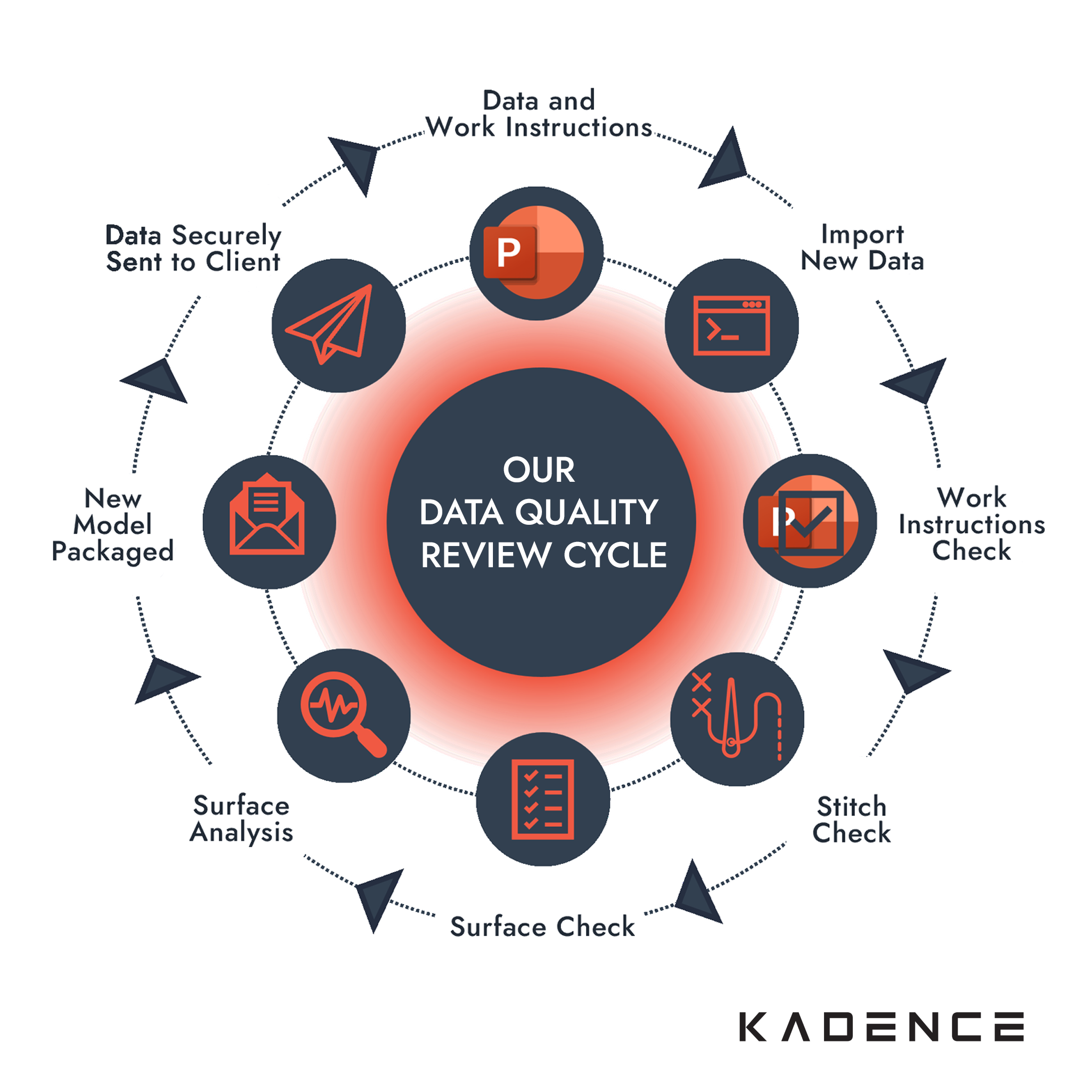
In automotive digital modelling, the quality of data transfer between client and supplier is as critical as the quality of the surfaces themselves. Yet it remains one of the most consistently underestimated risks in late-stage programme delivery.
Missed handovers. Incomplete briefs. Misaligned geometry. Each one triggers a chain reaction — rework cycles, delayed reviews, compressed timelines, and mounting pressure on teams already operating at capacity. The frustrating reality is that most of these issues are preventable.
Quality control must be embedded into the workflow from the start. Not applied as a final check, but built in, at every stage of the data transfer process.
At Kadence, this is how we operate. And in this post, we want to share the specific process we use to protect data integrity — and why it matters for the programmes we support.
The Real Cost of Poor Data Transfer
When data issues occur at the supplier interface, the consequences rarely stay contained.
A missing reference file delays the overnight team. An incomplete brief produces surfaces that don’t reflect the latest design intent. A geometry error that wasn’t caught before transfer requires a full rework cycle the following morning — consuming time that was never available in the first place.
These problems compound quickly. What begins as a minor data discrepancy can escalate into a programme-level delay if it lands during a critical review window. CAS sign-off, design freeze, tooling release — these are not moments where rework is an option.
The root cause is usually not incompetence. It is process. Specifically, the absence of a structured, repeatable approach to checking and verifying data at every point it moves between teams.

The Kadence Data Check Cycle
Kadence has developed and refined a Data Check Cycle that sits at the centre of every client engagement. It is not a single review point. It is a continuous quality discipline applied throughout the life of a work package.
The cycle operates across three stages.
Stage One: Brief Alignment
Before any data is transferred, the brief is reviewed in full. Reference models, design intent documentation, programme parameters, and technical constraints are all verified. Any ambiguities are resolved before work begins — not after.
This stage exists because the most common source of rework is not poor modelling. It is a misaligned starting point. A surface produced to an incomplete brief will require correction regardless of its technical quality. The Data Check Cycle eliminates this risk before it enters the workflow.
Stage Two: Pre-Transfer Review
Once the client-side work package is ready for transfer, Kadence’s Surface Design Liaison — where embedded on site — conducts a structured review before the data moves. Models are checked for completeness, reference integrity, and alignment with the agreed brief.
Nothing is transferred until this review is complete.
This is a deliberate quality gate. It ensures that our global surfacing team receives a clean, verified package — with no missing information, no conflicting geometry, and no ambiguity about design intent. The overnight team can begin work immediately, with full confidence in what they have received.
Stage Three: Return Transfer Verification
When completed surfaces are ready to return to the client, the same rigour applies. Surfaces are reviewed against the original brief, checked for quality and consistency, and verified before transfer. The client receives data that has been checked, not just completed.
This closing stage is where many supplier workflows fall short. The focus is on delivery speed, and final verification is treated as secondary. At Kadence, it is non-negotiable. What is returned to the client must be right — not approximately right.
The Role of the Surface Design Liaison
Central to the effectiveness of the Data Check Cycle is the Surface Design Liaison — a senior Kadence representative who, at the client’s discretion, embeds directly within the OEM’s design and engineering team.
This is not a project manager. It is an experienced surfacing professional who understands both the technical requirements of the programme and the design intent that underpins it. Their role is to maintain alignment between what the client needs and what the global Kadence team delivers — at every stage of the workflow.
By operating on site, the Surface Design Liaison closes the communication gap that is responsible for most data transfer issues. Feedback is immediate. Questions are resolved in real time. Design decisions are captured and communicated accurately before they reach the overnight team.
The result is a working relationship that functions less like a client-supplier dynamic and more like an extension of the internal team. As Wayne Morgan, Kadence’s Surface Head of Digital Modelling-Global Operations, describes it:
“Proper data transfer and alignment is paramount for both supplier and client. Efficiency is beneficial to both parties.”
That mutual benefit is the point. A clean, well-managed data workflow does not just protect Kadence’s delivery standards. It reduces the burden on the client’s internal team, removes unnecessary rework from the programme, and protects the timeline for everyone involved.
Why This Matters in Late-Stage Programmes
The Data Check Cycle is valuable at every stage of a programme. But its importance increases significantly as programmes approach critical milestones.
In late-stage delivery — CAS sign-off, design freeze, pre-production release — there is no margin for data-driven delays. Timelines are fixed. Review windows are scheduled. The cost of a rework cycle at this stage is not measured in hours. It is measured in programme risk.
This is precisely where a structured, repeatable data quality process proves its worth. Not as an administrative overhead, but as a protective layer that keeps the programme on track when the pressure is highest.
Senior modelling leaders at premium OEMs understand this instinctively. The question is not whether data quality matters. It is whether the supplier they are working with has the process in place to guarantee it — consistently, under pressure, across every work package.
Kadence does.
“It’s impressive how quickly the data is prepared for design review. Kadence’s rigour and discipline have enabled us to achieve our design intent, putting us ahead of our programme gateways through the quality of the data delivered.”
- OEM-Design Director
Precision Starts Before the Modelling Begins
There is a tendency in digital modelling to measure quality purely by the standard of the finished surface. That standard matters enormously. But it is only half of the picture.
The other half is the integrity of the process that surrounds it — the discipline of how work is briefed, transferred, reviewed, and returned. A technically excellent surface produced from a flawed brief, or delivered without a final quality check, does not protect design intent. It introduces risk at the moment it is most unwelcome.
At Kadence, precision digital modelling begins before a single surface is built. It begins with the data.
To find out more about how Kadence’s Data Check Cycle and overnight delivery workflow can support your programme, contact us at info@kadence.studio
Inside the Overnight Workflow: A US OEM Case Study
22/04/2026
Missed handovers, incomplete briefs, rework cycles — these are avoidable. But only if quality control is built into the surface design process, not applied at the end.